Angular, React, Vue: JavaScript frameworks compared
When thinking of Respond, Angular, and Vue, the 1st matter to observe is that they carry the exact same idea at their cores: knowledge binding. The idea right here is that the framework assumes the perform of tying the state of the software to the active aspects of the interface. Every framework has its individual idioms for accomplishing this, but it is the amplified clarity of design and style in state-driven knowledge binding that distinguishes this era of frameworks from the past a single.
This sort of computerized state-driven architecture is often referred to as a reactive technique.
State-driven factors
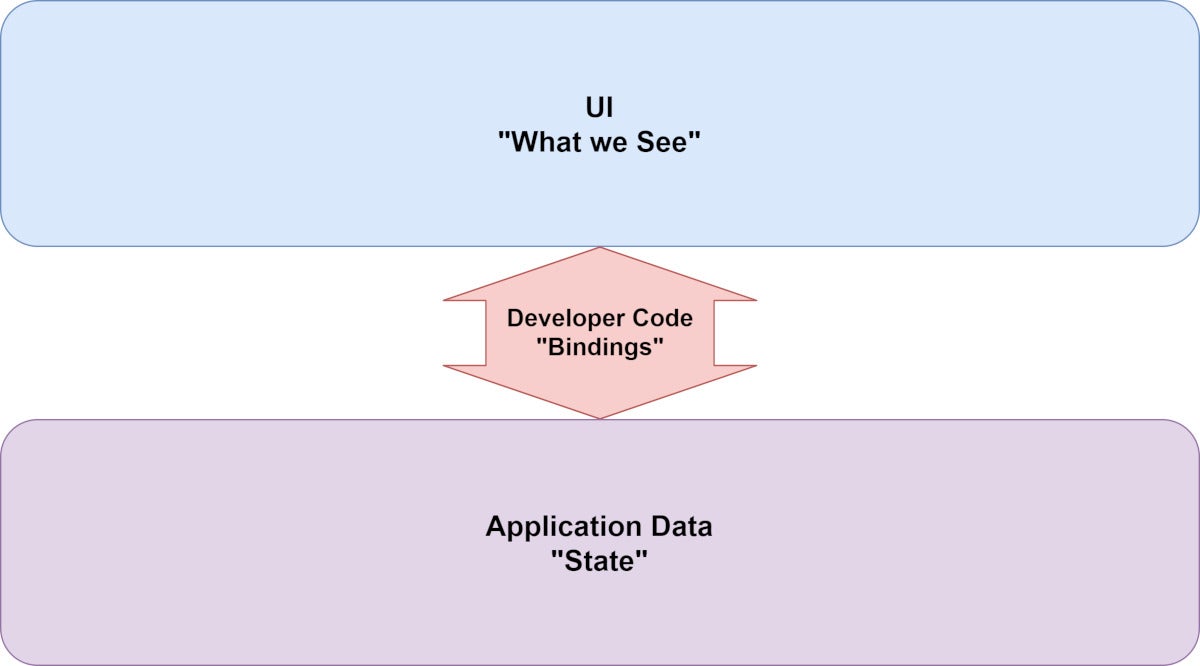
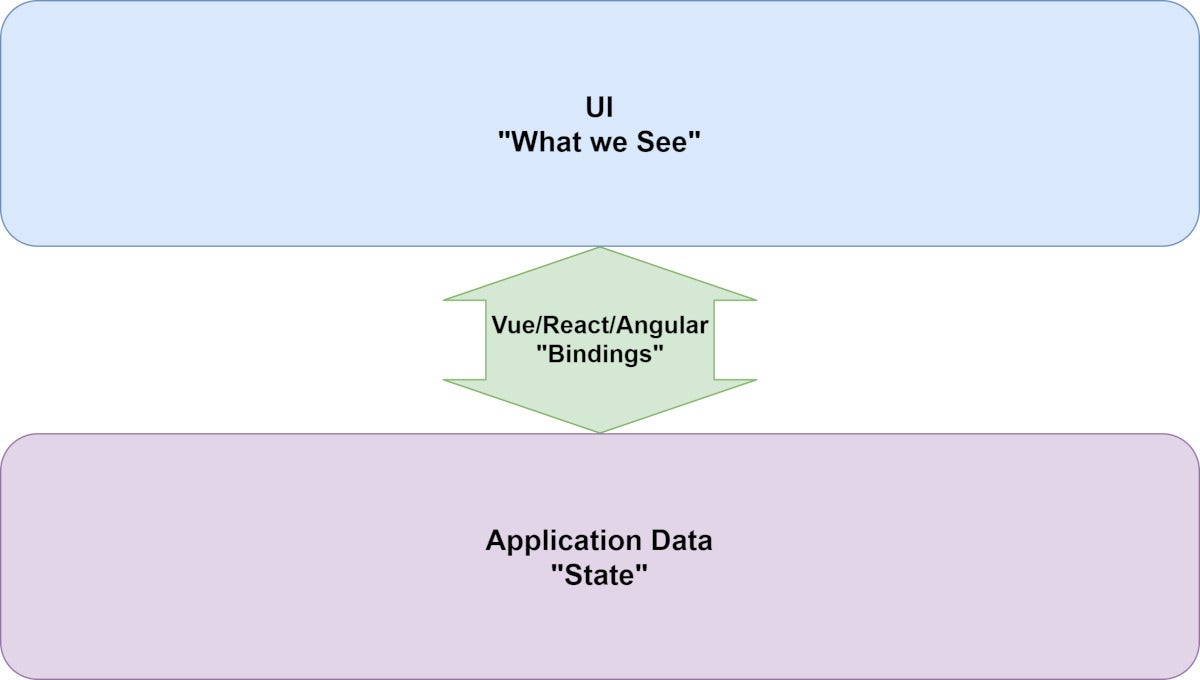
Figure one describes how state manifestation is handled without these kinds of frameworks. Figure 2 describes how it is handled with the frameworks.
Figure one. With no knowledge binding
 IDG
IDGFigure one.
Figure 2. With knowledge binding through Angular, Respond, and Vue
 IDG
IDGFigure 2.
Parts
The frameworks also align in getting component-primarily based. This is not a new idea: Every region of the consumer interface is represented by a component. The code in the component establishes what is exhibited and how the perspective behaves. Bundling state-driven knowledge binding into factors provides the critical gain to all three frameworks that can make them exceptional in elaborate interfaces to what went ahead of.
Industry adoption profiles
Now we will consider a glance at the existence of just about every framework in the sector, to get a glance at the stage of adoption and viability. What I imply right here is, when you choose a framework for a new challenge, or come to a decision on which framework to master, you want to be absolutely sure you are adopting a framework that is likely to be effective above the lengthy time period.
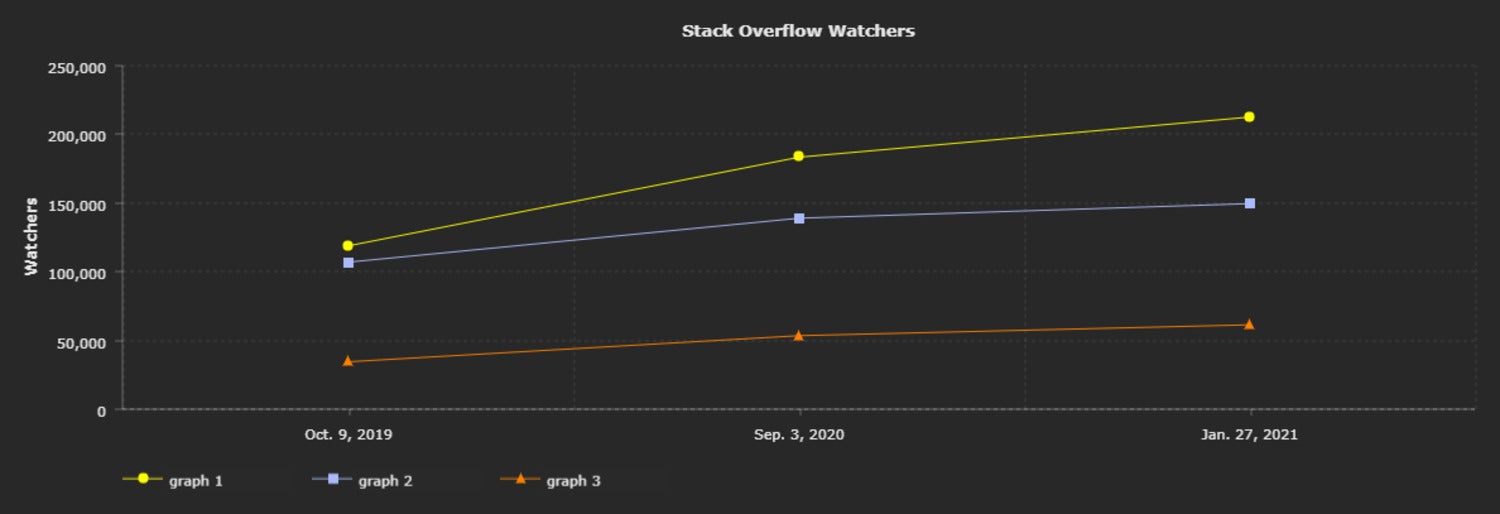
Figure 3 appears to be like at the selection of watchers just about every framework has on Stack Overflow. A several matters are very clear from this chart. All three frameworks have a sturdy existence on Stack Overflow, despite the fact that Vue is far driving with just above 50,000 watchers. ReactJS has a commanding lead, which has amplified above the earlier year.
Figure 3. Stack Overflow Watchers
 IDG
IDGFigure 3.
Figure 4 appears to be like at GitHub stars. Right here Angular usually takes past area, lagging far driving. Apparently, Vue is in the lead, and well ahead of Respond, indicating a good deal of curiosity (if not precise use) in the challenge. In just about every case, above the past year, the frameworks have shown expanding interest at about the exact same rate.
Figure 4. GitHub Stars
 IDG
IDGFigure 4.
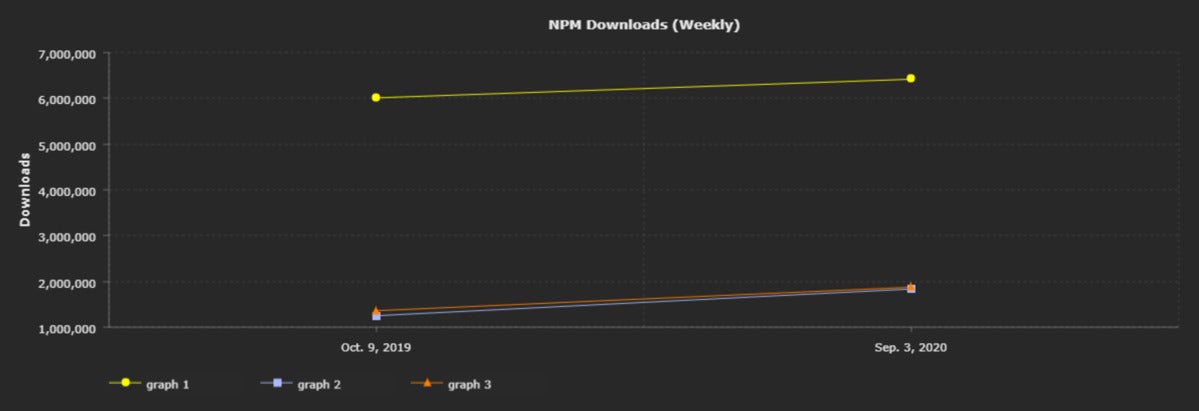
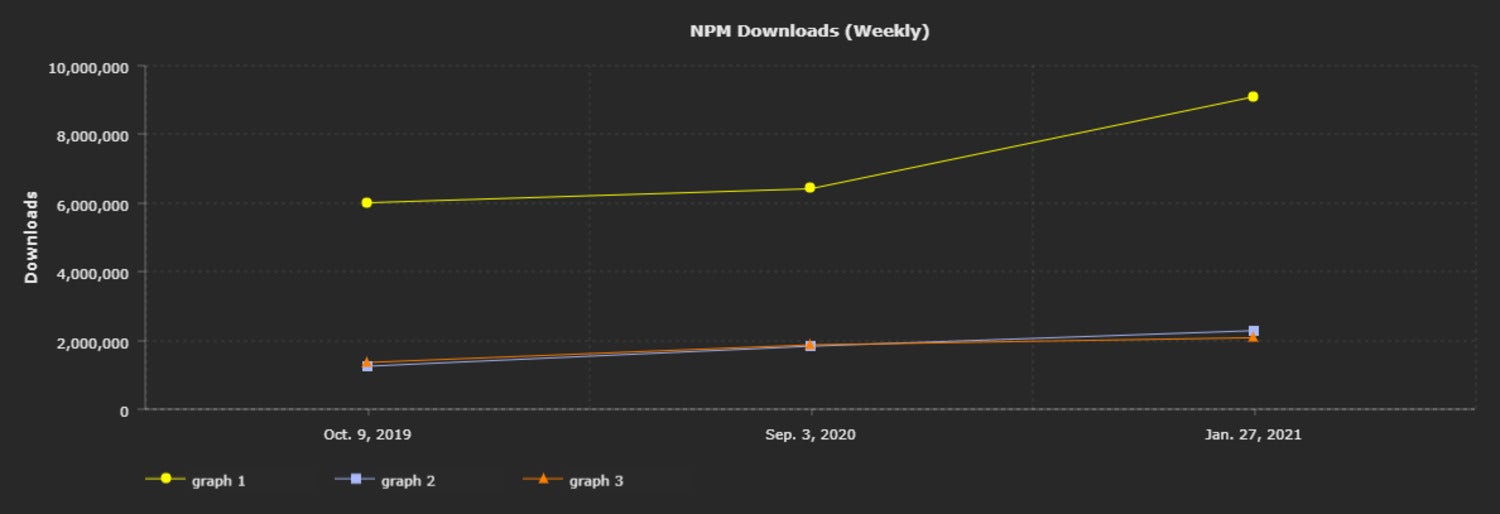
GitHub stars are likely to reflect people’s theoretical interest in a challenge. Figure five appears to be like at weekly NPM downloads, which is an indicator of active, simple use of the tasks.
Reputation consider-absent
Every of these frameworks appears to have ample up-consider to be lengthy-time period practical. React’s reputation usually means it is much easier to locate developers who know it, and much easier to locate businesses that are using the services of for it.
Figure five. NPM downloads (weekly)
 IDG
IDGFigure five.
The simple fact that leaps out in Figure five is that the precise active use of frameworks goes to ReactJS by a landslide. Respond has practically twice as lots of weekly downloads as the other two frameworks merged. It’s no shock that Respond is the most in-use framework, but it’s noteworthy just how sizeable its lead is.
Specialized comparison
You’ve seen how the frameworks are conceptually very similar, and had a glance at their relative existence in the sector. Now let us have a glance at their specialized areas.
Angular
Angular 2+ was “designed from previously mentioned.” That is, a bunch of smart people sat down and decided what would make for the greatest entrance-end JavaScript framework.
In lots of strategies, they succeeded: Angular is a pretty complete framework. On the other hand, Angular can really feel overpowering to master and use the framework, as you are quickly necessary to learn a massive established of interacting aspects (products and services, dependency injection, etc.) to reach anything.
Angular is supposed to integrate every little thing you may well need to have to create massive-scale entrance finishes. In comparison, Respond relies upon community-designed plug-ins (for router support, for instance).
Eventually, you as a developer are inside of a code-thought-equipment that wants you to conform to its ideals and conventions.
On the in addition aspect, the wholesale adoption of ReactiveX (RxJS) across the board is innovative and ahead-considering. Not only does it imply all the celebration managing desires (intra-component, inter-component, back again-end support calls, etc.) are managed through the exact same system, but the exact same well-crafted framework (ReactiveX) and its finding out will transfer to any other language you can consider.
Moreover, massive-scale tasks with lots of group customers might reward from the a lot more rigid and well-outlined architectural type current in Angular.
There are different thoughts about the advantages and drawbacks of TypeScript, but you will code and browse TypeScript if you use Angular. An additional govt up-entrance final decision.
Angular adopts ECMAScript courses wholesale. These courses use the crafted-in state as the component state. These are embellished with annotations to outline their metadata.
Sights in Angular are very similar to sights in Vue in that they are straight HTML templates with more knowledge-binding and logic support through inline directives.
Angular employs NgRX/retailer as its crafted-in, centralized state management plug-in.
Angular component instance
Listing 2 displays a counter component very similar to the Respond instance, and is derived from this instance.
@Ingredient(
selector: 'app',
template: `
counter
`
)
export course App
general public counter : selection =increment()
this.counter += one
decrement()
this.counter -= one
bootstrap(App, [])
Observe the @Ingredient annotation. This is a “decorator” that informs Angular that the JavaScript course that follows is a component. Other characteristics like products and services are handled in a very similar trend.
Also notice that the state is handled as a course member: general public counter. This is a pretty thoroughly clean way to establish factors atop JavaScript’s indigenous syntax.
The interactive component of the component is extra to the button aspects through the (click) directive that is analagous to the DOM method onClick, but will allow for contacting techniques on the component course. In this case it executes the increment and decrement techniques.
At last, the inline token counter will allow for outputting the knowledge-bound variable. This is marginally diverse from React’s syntax, but practically the exact same, and serves the exact same function.
Respond
React’s energy is that it has organically grown up from in-the-earth use and has ongoing to create in response to significant use. It has been through in depth advancement, but its roots and ongoing benefits reside in its getting a framework employed by Facebook for its individual programs.
You can see Facebook’s committment to driving innovation in the framework with ahead-hunting characteristics like Concurrent Manner (nonetheless in experimental mode at the time of creating).
Respond has also aggressively designed what is recognised as “pure” or purposeful factors and hooks to empower them. These factors stay away from some of the overhead of course-primarily based factors. Vue has some support for purposeful factors, and it is feasible to create them in Angular, but Respond is the very clear leader in this region.
Ingredient definition and interactions are somewhat uncomplicated in Respond, honoring the principle of minimum shock.
As lengthy as you stay away from needless Redux use, the managing of Respond with a massive-scale software is as fantastic as Vue. Angular handles massive code bases in a steady method and can offer advantages above Respond in this region. It is feasible to outline tasteful massive-scale applications in Respond, but the framework alone isn’t likely to do as a great deal as Angular to implement that definition.
Respond employs an immutable state object accessible only through setState() to stand for component state. This is diverse from Vue and Angular, which make use of a a lot more crafted-in JavaScript solution to state knowledge.
Respond employs JSX for its perspective templates. JSX is an interesting solution in that it is like HTML with JavaScript superpowers (or JavaScript with HTML superpowers, if you desire). JSX can be a little bit off-putting when 1st finding out the framework. It performs fairly well in the lengthy operate and is not hard to master if you arleady know HTML and JavaScript.
React’s default centralized knowledge management is handled through Redux.
Respond component instance
Listing one has a basic component instance in Respond, derived from the Respond docs. This is a purposeful component, as that is the major way to establish factors likely ahead.
import Respond, useState from 'react'perform Instance()
const [count, setCount] = useState()return (
You clicked count moments
)
Observe how the state is handled through the useState “hook.” This exposes the setCount() method to the template. The template is returned by the precise component perform, and is created in JSX. JSX will allow the inline integration of the JavaScript perform into the onClick attribute of the button aspect, which interacts with the component state. The state is also accessed through the count token in the template markup.
Vue
Vue adopts a “normal JSON object as state” philosophy. Any time you can just use the language alone, it’s a earn for simplicity. So you are going to locate Vue easier in this regard than React’s setState(), for instance. Nevertheless, there are edge scenarios and caveats that in the long run imply you are dealing with a indigenous-JSON-hybrid beast.
In a perception, Vue is someplace involving Angular and Respond, a compromise involving Angular’s major-down design and style and React’s natural and organic advancement.
Regardless of getting the most recent contender, and missing the backing of a massive company, Vue has held tempo with developments and provides a fully practical framework. Also, there are a selection of high-quality plug-ins and kits for Vue (like Quasar and Vuetify).
Vue has a status for getting the easiest to master. That possibly derives from its JSON knowledge model and HTML-with-decoration perspective definitions (versus React’s JSX). Vue templates can also integrate inline JavaScript capabilities, as opposed to JSX.
Vue delivers Vuex as its crafted-in, centralized state management answer.
Vue component instance
Listing 3 displays a basic component definition in Vue, from the Vue docs.
// Determine a new component identified as button-counter
Vue.component('button-counter',
knowledge: perform ()
return
count:
,
template: ''
)
In Listing 3, you can see that the component is exported as a CommonJS module. This is the Vue idiom for defining the component code. The template is identified as the template member.
Within just the object that the module exports is the knowledge member. This is a perform that returns an object defining the component’s state.
Observe that the template will allow for HTML with inline directives like v-on:click, very similar to Angular’s (click) or React’s onClick. The syntax in Vue for outputting bound variables is the exact same as Angular: count.
General performance comparison
General performance can be challenging to get a tackle on. This outstanding short article delivers a knowledge-primarily based comparison of the three frameworks in three locations: DOM manipulation, load time, and memory allocation.
In the groups: Angular wins for DOM manipulation (in most scenarios) Vue wins for load moments Respond and Angular earn for memory allocation.
In basic, it’s not terribly beneficial to make a overall performance-primarily based final decision among the the frameworks. How you use them will make the largest effects on overall performance.
Native support and server-aspect rendering
Despite the fact that Vue and Angular also support to-indigenous characteristics and server-aspect rendering, Respond appears to be holding well ahead in phrases of the simplicity in using these. JSX has a fantastic really feel for me personally, in that it keeps relevant code and layout near collectively. Other individuals have had a much less pleased expertise with it. Total, I count JSX as a beneficial for Respond.
Which framework to use?
The question as to which engineering is greatest is not possible to say definitively. There are quantitative variances, but in the end it is a qualitative final decision.
As with lots of engineering selections, exterior elements can enjoy a large function. In specific, your familiarity with the frameworks and that of your group will weigh intensely. Availability of developers who know the tech is also crucial, and in that arena, Respond is the very clear winner. The Respond challenge also appears the most fully commited to offering ahead-hunting innovations.
That getting said, Angular stands out as an architectural framework capable of dealing with massive-scale tasks in a steady and highly effective way. And Vue delivers an much easier finding out curve with a easier state modelling and eventing technique.
In the end, it would be perfect to get a really feel for just about every framework, recognizing that just about every is sturdy engineering, with outstanding community support and on-likely progress.
Copyright © 2021 IDG Communications, Inc.